

Anxiety doesn’t always start in your head. Through the gut-brain axis, a constant two-way line of communication between your digestive system and your brain, the state of your gut can shape how anxious, flat or calm you feel.
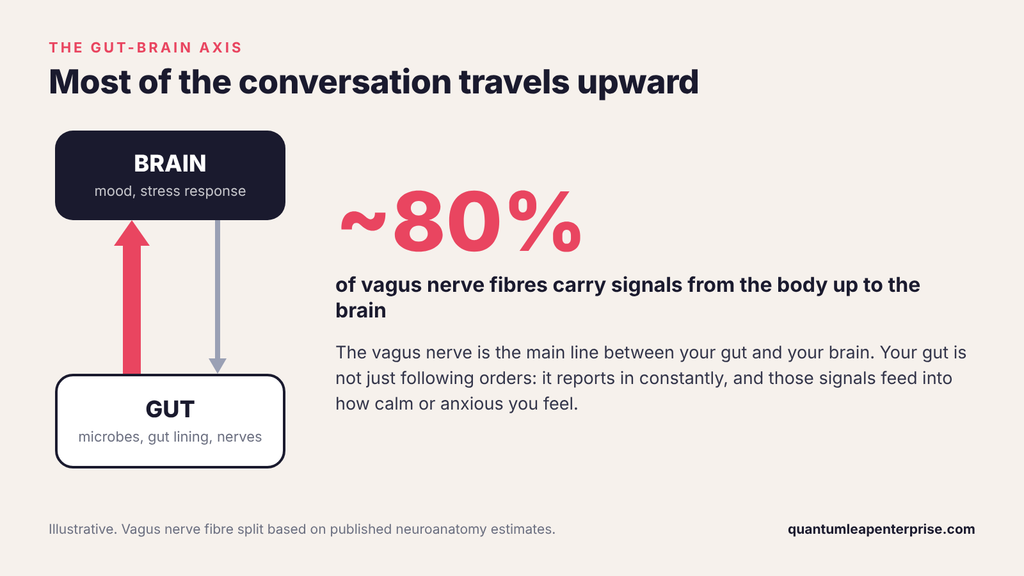
Most of that traffic actually travels upward, from gut to brain. So when anxiety shows up, your gut is a legitimate place to look, alongside your thoughts, your sleep and your stress.
What is the gut-brain axis?
The gut-brain axis is the network of nerves, hormones, immune signals and microbial chemicals that connects your digestive tract to your brain. Its main physical line is the vagus nerve, running from your brainstem down into your abdomen.
Here is the part most women have never been told: around 80 per cent of vagus nerve fibres carry information from the body to the brain, not the other way round. It is reporting in, all day, and your brain is listening.
Can gut health cause anxiety?
Can gut health cause anxiety on its own? Rarely as the single cause, but it is a real contributor that is routinely ignored.
Your gut microbes produce compounds that influence inflammation, stress hormones and neurotransmitters such as serotonin and GABA. Around 90 per cent of the body’s serotonin is made in the gut.
That gut serotonin does not travel straight to the brain, but it does act on the nerves of the gut, including the vagus.
Research on the gut-brain axis repeatedly links a less diverse microbiome with higher rates of anxiety and low mood. Cause and effect are still being mapped, but the pattern is strong.
For women, there is an extra layer. Oestrogen and gut bacteria influence each other, which is one reason gut symptoms and mood can both shift across your cycle and through perimenopause.
Women are also around twice as likely as men to experience an anxiety disorder, and more likely to live with IBS. Gut health and anxiety are one conversation, not two.
Why stress shows up in your stomach
If you have ever felt anxiety as nausea, a knotted stomach or a sudden dash to the loo, you have felt the gut-brain axis working in the other direction.
Under stress, your brain diverts energy away from digestion, changes how your gut moves and makes the gut lining more permeable.
Over time, that stress state alters the microbiome itself. A stressed gut then sends more distress signals upward, and the loop tightens.
This is why gut health and anxiety so often travel together, and why treating only one end of the loop can leave you stuck.
How to support your gut-brain axis
You cannot think your way out of a signal that starts in your gut, but you can change what it sends. These are the evidence-informed foundations:
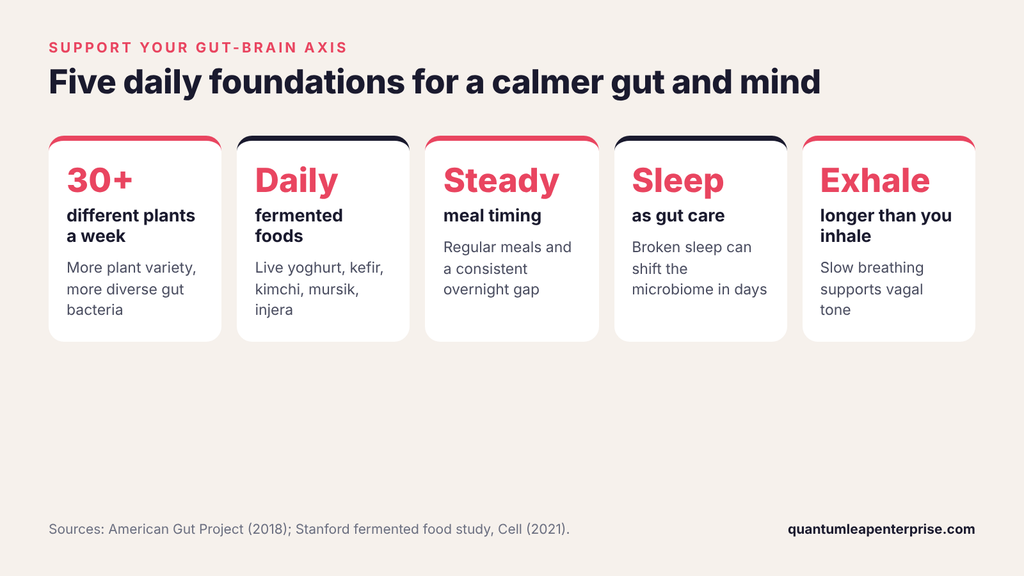
- Plant range, not just volume. The American Gut Project found that people eating 30 or more different plants a week had more diverse gut bacteria than those eating 10 or fewer.
- Fermented foods every day. A 2021 Stanford study found that a diet high in fermented foods increased microbiome diversity and lowered markers of inflammation within ten weeks.
Live yoghurt, kefir and kimchi are easy starts. - Steady meal timing. Your gut runs on a body clock. Regular meals and a consistent overnight gap support the microbes that protect your gut lining.
- Sleep as gut care. Short or broken sleep can shift the microbiome within days, and a disrupted microbiome makes sleep harder. Protect a regular bedtime.
- Calm the vagus directly. Slow breathing with a longer exhale, humming and a gentle walk after meals all support vagal tone, the measure of how well your body switches back to calm.
A different place to start
Supporting your gut-brain axis is not a replacement for mental health care. If anxiety is affecting your daily life, speak to your GP and mention any gut symptoms in the same appointment.
What changes is the starting point. So, can gut health cause anxiety? It can certainly feed it, and that is useful news, because your gut is something you can work with.
Sometimes anxiety is your body asking, through the gut-brain axis, for steadier meals, more plants, deeper sleep and a nervous system that is allowed to rest.
Your daily ritual with 777Aura

Small daily rituals are how gut health and anxiety support actually sticks. 777 Aura was created for that moment: a 60ml Scottish-crafted elixir, made with seabuckthorn or honeyberry and designed to be drunk with intention as part of your morning. Explore the range at 777aura.com
This article is for general information and is not a substitute for medical advice. If you are worried about your symptoms, speak to your GP.