
The symptom overlap nobody separates, and the questions to take to your GP

Burnout or perimenopause? If you are a woman in your late 30s, 40s or early 50s who feels exhausted, foggy and short-fused, it could be either, or both. The symptoms overlap almost completely.
The pattern of your symptoms, not the symptoms themselves, is what tells them apart, and once you know what to look for, you can walk into your GP appointment with a clear question instead of a vague complaint.
Why burnout or perimenopause is so easy to confuse
Exhaustion, brain fog, low mood, poor sleep, irritability and a shrinking tolerance for stress appear on both lists. Both also tend to arrive in the same decade, when careers peak and many women are caring for children and parents at the same time.
The World Health Organisation defines burnout as an occupational phenomenon caused by chronic workplace stress that has not been successfully managed.
Perimenopause is the hormonal transition before your final period, usually starting in your 40s and lasting several years. The average age of menopause is 51.
The result is that thousands of women spend years treating a hormonal transition as a time management failure. Others are told it is “just hormones” when their workload is the real problem. Asking burnout or perimenopause is the right question. Most women are simply never shown how to answer it.
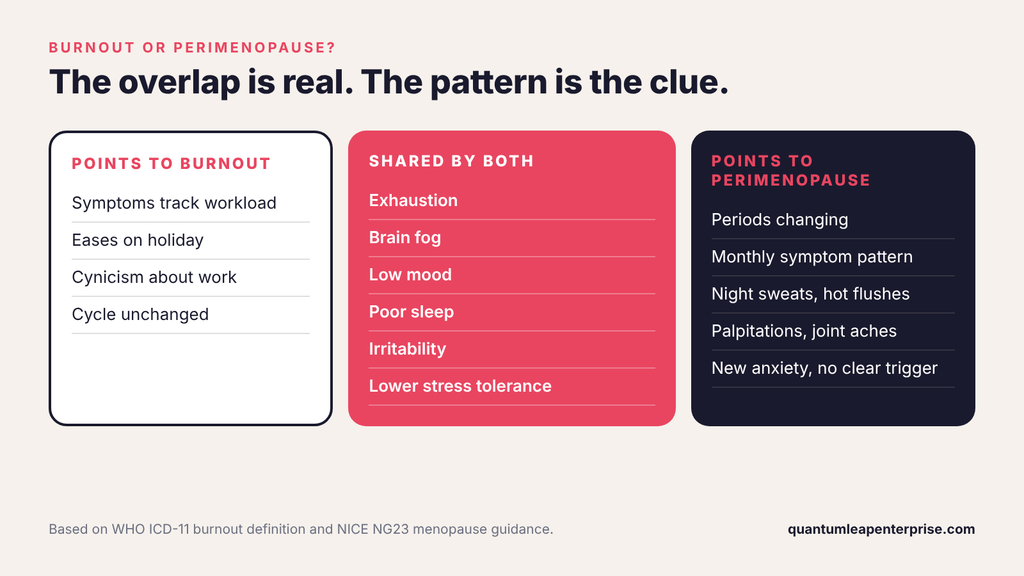
Burnout or perimenopause: signs that point to burnout
- Your symptoms track your workload. They ease noticeably on holiday and return within days of being back.
- You feel detached or cynical about work. Dread on Sunday evenings, mental distance from your role and a sense that nothing you do makes a difference are core features of burnout.
- Your cycle has not changed. Periods arrive at the same intervals, with the same flow.
- Rest helps, at least for a while. A proper break restores you, even if the effect fades.
Burnout or perimenopause: signs that point to perimenopause
- Your periods are changing. Shorter or longer cycles, heavier or lighter bleeding, or skipped months are the clearest signal.
- Symptoms follow a monthly rhythm. Mood, sleep and energy dip predictably, often worse in the week before a period.
- Physical signs that burnout does not explain. Night sweats, hot flushes, palpitations, new joint aches, headaches or vaginal dryness.
- Perimenopause brain fog. Losing words mid-sentence, walking into rooms with no idea why, and struggling to hold a thread you once managed easily. A holiday does not shift it.
- Perimenopause fatigue that rest does not touch. Waking at 3 am, unrefreshing sleep and tiredness that survives a week off.
- Anxiety or low mood that is new for you, without an obvious trigger.
Signs that point to neither
Some of this picture comes from somewhere else entirely. Iron deficiency, particularly if your periods have become heavier, can cause perimenopause fatigue lookalikes. So can an underactive thyroid, low vitamin D or B12, blood sugar problems, depression and sleep apnoea.
This is why perimenopause brain fog and exhaustion deserve blood tests, not guesswork.
Burnout or perimenopause can also be both. Falling oestrogen lowers your stress tolerance, so a workload you handled at 38 can tip you into burnout at 46. It is rarely a clean either-or.
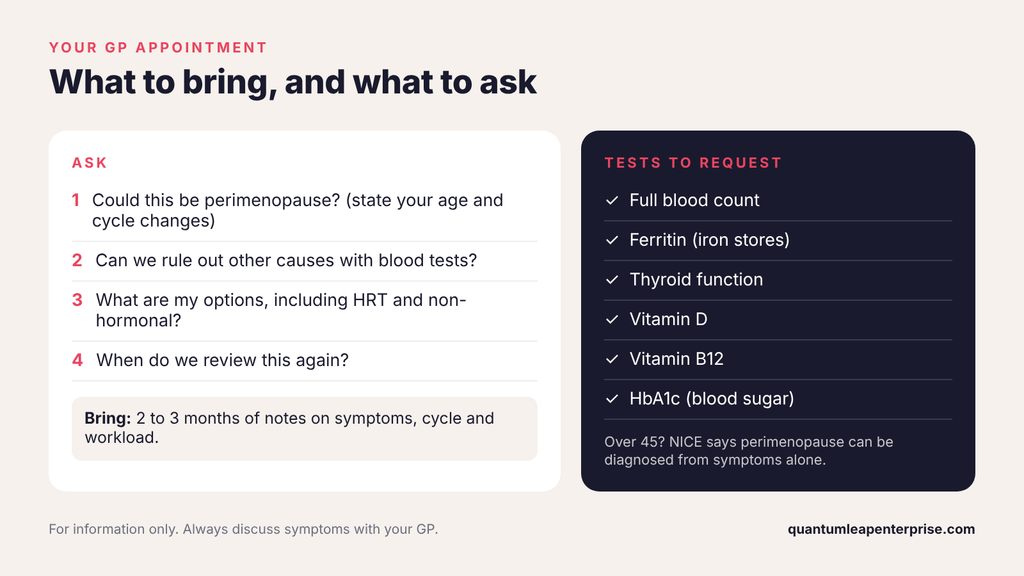
Questions to take to your GP
Under NICE guidance, women over 45 can be diagnosed with perimenopause from their symptoms alone, without a blood test.
Hormone levels swing from day to day during perimenopause, so a single FSH test is often unhelpful in this age group. For women aged 40 to 45, an FSH test may be considered.
If you suspect burnout or perimenopause, go in prepared:
- “I’m [age] and my cycle has changed in these ways. Could this be perimenopause?”
- “Can we rule out other causes with a full blood count, ferritin, thyroid function, vitamin D, B12 and HbA1c?”
- “If it is perimenopause, what are my options, including HRT and non-hormonal approaches?”
- “How can we review this again in three months?”
Bring evidence. Track your symptoms, your cycle and your workload for two to three months before the appointment. That diary is what separates burnout or perimenopause on paper, and it makes your symptoms much harder to dismiss.
You are not failing
Perimenopause fatigue and perimenopause brain fog are not signs that you have lost your edge. Burnout is not a character flaw either.
Both are information. When you know which signal you are reading, you can stop pushing harder and start asking for the right support.
This article is for general information and is not a substitute for medical advice. If you are worried about your symptoms, speak to your GP.
One Response